

Business Intelligence has become a key strategic ally for companies that want to succeed in any industry. In a world where the volume of information and data grows every day, the ability to transform raw data into actionable insights has never been more necessary.
Companies that invest in structured data and BI tools can grow between 15% and 25% above the market average, according to a study by McKinsey.
Currently, the market offers several Business Intelligence tools, each with specific characteristics and audiences. With that in mind, we have prepared a list of the best BI tools to help you find the tool that best aligns with your strategic objectives.
What are BI tools?
BI tools are a set of applications, platforms, and technological solutions specialized in data analysis, allowing companies to make strategic decisions based on real information and data.
The unique feature of BI platforms is their ability to convert raw data into structured and actionable insights.
This transformation process not only improves the quality of business decisions, but also optimizes internal operations, reduces risks, and strengthens a company’s competitive position in increasingly data-driven markets.
Best BI tools
Choosing the ideal BI platform for your company requires evaluating factors such as scalability, ease of use, available integrations, and alignment with your specific goals. We will address this later to help you choose the best tool.
But before that, we have compiled a list of the main BI tools on the market. Explore the options below and identify which solution best aligns with your business strategy.
1. Microsoft Power BI
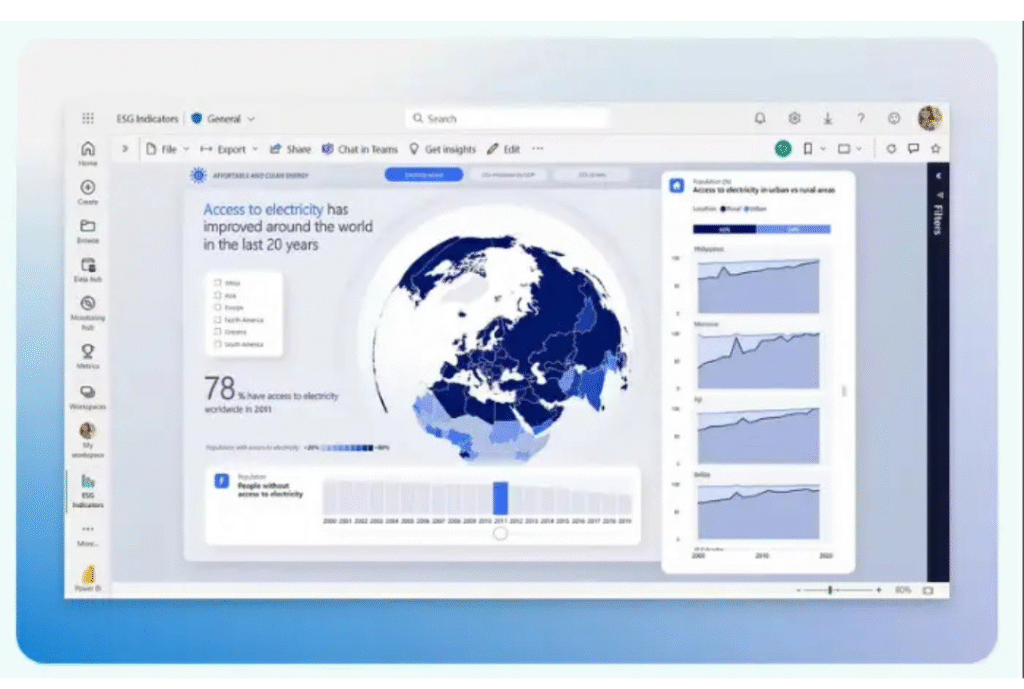
For companies looking for a robust, scalable solution that integrates with the Microsoft ecosystem, Power BI is a strategic and reliable choice.
Developed by Microsoft, Microsoft Power BI is one of the most widely used BI platforms on the market. The platform was specifically designed to manage data centrally, allowing companies to make strategic decisions based on reliable and efficient analyses.
The solution offered by Power BI goes beyond simple data visualization. The platform integrates with other tools such as Microsoft Excel, allowing teams from different departments to generate insights without continuous dependence on IT professionals.
2. Looker Studio
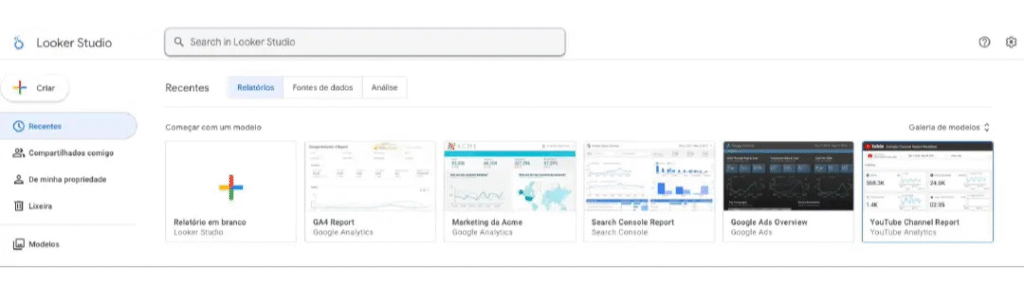
Looker Studio is a free BI tool created by Google and widely used by companies of different sizes seeking to optimize data analysis without large initial investments.
The tool integrates seamlessly with the Google ecosystem, connecting to corporate data sources through Google Sheets and Google Ads, enabling efficient consolidation and visualization of critical information.
3. Oracle Analytics Cloud
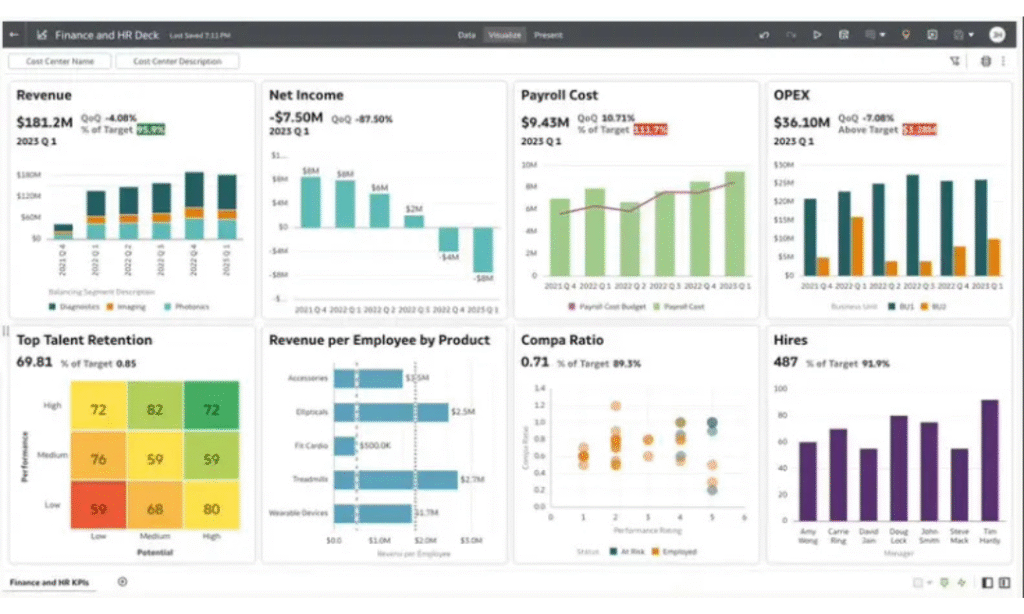
Oracle Analytics Cloud is a business intelligence platform for companies that manage large volumes of data and require performance, reliability, and scalability in their analytical operations.
Integration with Oracle Cloud Infrastructure allows the platform itself to manage critical maintenance tasks, such as patching, backups, data restoration, and service management, reducing the burden on your IT team.
The platform allows you to schedule intelligent alerts based on data behavior, enabling organizations to receive automatic notifications about anomalies or significant changes in indicators.
4. IBM Cognos Analytics
IBM Cognos Analytics is a BI platform designed to integrate different data sources, identify patterns, and perform advanced analytics with the support of artificial intelligence. Its purpose is to offer efficiency and depth in the interpretation of strategic information, empowering data-driven business decisions.
Its unique feature is its flexibility of implementation, working in public cloud, private cloud, multicloud, local infrastructure, or integrated with IBM Cloud Pak for Data. This versatility ensures adaptation to security and governance requirements.
5. SAS Business Intelligence
SAS is a BI tool focused on predictive analytics and advanced data mining, recognized for the accuracy of its models and the depth of its insights. It allows you to transform large volumes of data into efficient visualizations and highly actionable analyses.
Its unique feature is that it simplifies the entire analytical cycle: preparation, cleaning, modeling, and visualization. With desktop and mobile access, unstructured text analysis, and intuitive dashboards, SAS is easy to use for different professional profiles, accelerating decisions and increasing team autonomy.
6. BIRT
BIRT is an open source BI platform designed for creating complex reports, interactive dashboards, and visualizations that can be integrated into web applications and corporate systems.
Its open architecture allows for complete code customization, offering high flexibility for technical teams seeking adaptable solutions without licensing costs.
Because it is free, BIRT attracts startups and companies with limited budgets, as long as they have internal expertise for maintenance and implementation.
7. Adobe Analytics
Adobe Analytics is a BI platform focused on customer behavior analysis, allowing you to capture and interpret data in real time throughout the consumer journey. The solution generates comprehensive reports enriched with predictive intelligence, offering strategic insights to optimize products and services.
With the flexibility to create customized reports and connect to multiple data sources, Adobe Analytics delivers detailed forecasts based on decision scenarios. It is an excellent choice for companies seeking in-depth behavioral analysis and improvement of the customer experience.
8. Qlik
Another excellent business intelligence platform option is Qlik. This tool enables efficient data analysis, providing active intelligence on a data analytics platform that integrates information and operates in the cloud, in real time and from end to end.
This strategy has paid system versions, but it can also be considered a free BI tool, as the company offers three versions of its program with free access: QlikView Personal, Qlik Sense Desktop, and Qlik Sense Cloud.
9. Tableau
Tableau is a Business Intelligence platform developed and launched in 2003, designed to enable organizations to understand their data and manage insights in a simplified and straightforward manner.
The tool offers a robust analytical solution that integrates seamlessly with CRM systems, providing enhanced governance, centralized management, and effective collaboration between teams.
10. Domo
Domo is a fully cloud-based BI platform with a user-friendly interface, pre-built connectors, and a simplified ETL solution that make Domo particularly accessible to novice users and teams without deep technical knowledge.
The platform offers a limited free version for evaluation and experimentation. After the trial period, Domo offers three credit-based pricing tiers allowing unlimited teams as long as resource consumption remains within the purchased credits.
How to choose the best BI tool?
Selecting the right Business Intelligence tool for your organization requires careful evaluation of several strategic and operational factors. Consider the aspects below to ensure a choice that aligns with your specific needs.
Ease of use
A modern BI tool should be intuitive for both specialized data analysts and non-technical members of the organization. Data democratization is essential for all employees to be able to access, analyze, and extract insights regardless of their technical background.
Platforms that facilitate this accessibility expand the use of data in decision-making at all hierarchical levels, strengthening the company’s data-driven culture.
Integration capabilities
Isolated data represents one of the biggest obstacles to effective analysis in organizations. BI tools must integrate and consolidate data from multiple sources, creating a single, reliable source of truth for the entire organization.
This consolidation not only increases collaboration between departments, but also cultivates a data culture that drives sustainable growth and competitive advantage.
Pricing and scalability
As companies grow, their data needs evolve in volume, complexity, and diversity of sources. BI tools should be designed to scale along with the organization, supporting growing volumes and increasingly sophisticated analysis.
Pricing structures vary significantly. Consider your current number of users, future growth potential, and infrastructure capacity when evaluating pricing options. Choose flexible models that accommodate expansion without incurring prohibitive costs.

What are the main points of Business Intelligence?
To effectively implement Business Intelligence in organizations, it is essential to understand its three fundamental pillars. These pillars strategically structure data analysis and can only be fully consolidated with tools capable of transforming scattered information into actionable and measurable insights.
1. Strategy
In the corporate strategic context, BI practices and tools optimize organizational performance and maximize revenue through contextualized analysis.
This pillar supports critical decisions such as marketing campaigns, commercial proposals, and initiatives that directly impact customer satisfaction.
The technology identifies organizational strengths and weaknesses, sets balanced goals, and continuously monitors the progress of metrics toward defined strategic objectives.
2. Analysis
The analytical pillar enables organizations to examine data and generate reports in real time, allowing proactive monitoring of risks and identification of bottlenecks that limit operational results. This continuous visibility enables agile adjustments based on concrete evidence.
3. Operation
The operational pillar represents applied business intelligence, converting data from the strategic and analytical spheres into more effective performance models. This process generates assertive solutions to optimize the company’s competitive positioning and continuously improve internal processes.
How to use Business Intelligence tools?
Effective implementation of Business Intelligence requires following four fundamental strategic steps that ensure maximization of corporate data value.
First, data collection involves capturing thousands of sensitive and non-sensitive pieces of information generated daily by the organization. Tools such as CRM systems facilitate this collection, providing raw material for targeted and customized business strategies.
The organization and analysis of data is crucial for filtering information according to service priorities, sales, and specific business objectives. Structured data allows for more accurate analysis and more relevant insights.
The conversion of data into information represents the moment of transforming raw data into strategic insights that guide business decisions. This step is fundamental for the application of new competitive strategies.
Finally, the measurement of results evaluates the impact of changes implemented based on BI insights. This continuous analysis determines the effectiveness of the tools and strategies adopted, allowing for constant adjustments and optimizations.
How does AI help Business Intelligence?
Artificial Intelligence has become a strategic ally for the management of industries and distributors, optimizing everything from sales process automation to large data volume analysis.
When integrated with Business Intelligence, AI significantly improves decision-making quality, making choices faster, more accurate, and based on concrete information.
The combination of AI with BI platforms offers managers robust support to consolidate strategic insights and maximize operational efficiency. The main benefits of this integration include advanced capabilities that transcend traditional analytics.
Advanced data interpretation
Natural Language Processing technologies enable BI systems to collect and analyze data from human language, making the interpretation of information significantly faster and more accurate. This capability eliminates technical barriers and democratizes access to complex insights.
Automation in the analysis of large volumes of data
AI processes complex information on a massive scale, identifying subtle patterns and hidden variables that manual analysis would be unlikely to detect. This automation frees teams up for strategic activities with greater added value.
Monitoring customer and market behavior
AI systems automatically evaluate market fluctuations and consumption patterns, providing accurate projections and valuable insights to anticipate competitive trends. This predictability enables proactive positioning in the market.
Automatic generation of strategic reports
AI dramatically streamlines the creation of dashboards and detailed reports, allowing managers to make informed decisions without the need for time-consuming manual data processing. Automated reports ensure consistency and continuous updating of critical information.
Continuous improvement of operations
AI systems continuously learn from collected data, refining analyses over time and optimising business processes in an evolutionary way. This constant learning generates sustainable incremental improvements.
With the integration of BI and AI, managers in industries and distribution companies are moving from time-consuming and subjective analyses to a management model guided by concrete data. This translates into greater competitiveness, improved operational control, and robust predictability for sustainable business growth.
Have you found the best BI tool?
We hope this article has helped you find the best Business Intelligence platform to analyze and visualize your company’s data.